

Joel Levitt working with Shutdown planning crews at Syncrude in Ft McMurry, Alberta Canada
Shutdown type events are the most visible, consequential, and complicated events in a plant’s existence. Small improvements in any area can result in massive savings and improvement.
This program is for:
This course is for heavy maintenance environments, including refineries, power plants, chemical plants, mines, large factories, and other extensive facilities. It is precisely for project managers, outage planners, planners, maintenance managers, project engineers, supervisors, maintenance engineers, and people in training for these positions.
This course is also designed for contractors who manage entire or parts of client shutdowns. Prior background in Project Management would be helpful but not essential. The best use of this course would be for an organization planning a shutdown or outage shortly.
Promise of the course :
We promise that people of all levels of experience will learn new things about shutdown type events. They will understand the overall picture and see the details needed for success. The result of these understandings will be enhanded ability to plan for and execute shutdown type events
A few things you will learn:
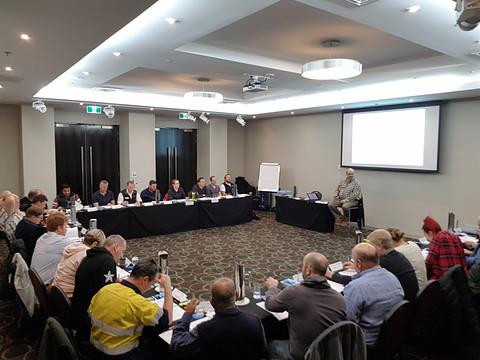
Shutdwon Discussion, Perth Australia
Information about course :
Selection of Learning Objectives
The Report card introduces the student to the class. They get to evaluate their shutdown program and see where there is room for improvement.
In the exercise on meetings, the student can look at the meeting rules they follow and pick some areas where extra attention would enhance the shutdown effort
Preparing a Typical Timeline exercise is designed to show the student the benefit of managing the Shutdown intensively from conception to closeout
Estimating exercise takes a typical shutdown job and shows the students how to micro-plan a job.
Do you have enough time to plan and schedule the Shutdown properly? The Planning lead times exercise will show that and show how many people will be needed if you don’t
The Critical Path Method (CPM) Exercise tests the student’s new knowledge of shutdown activity scheduling. It starts with a worklist and has the students develop a CPM network diagram highlighting the critical path and the Shutdown duration.
Different people are different types of learners. The seminar features many other training modalities. This course has several exercises to help enhance the training experience and teach specific skills to help manage shutdowns.
The Master Check List series of exercises (one list for each phase) is unique for this course. Each student will receive and review a master checklist developed over the last 20 years of items that have caused problems on past shutdowns. The checklists are updated as new people take the course and contribute their experiences
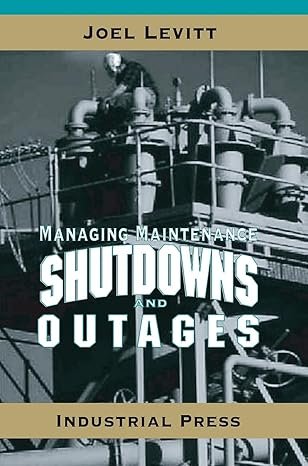
Offered with this course is Managing Maintenance Shutdowns and Outages, published by Industrial Press, NY. This 208-page book outlines all aspects of shutdowns from conception to closeout and post mortem.
There are a variety of course lengths and configurations
Virtual Online | Live On-site |
15-24 hours contact time | 9 am to 4 pm daily With lunch |
5-Day 5,4, Hour 8-Day 3, 3-Hour 3- Day 6-Hour And shorter | 2-days 3- days 5-days |
Can be scheduled 1,2,3 sessions per week with homework | Contigous |
Mastering the Basics of Shutdowns, Turnarounds, and Outages
Group activity: Quick report card- Exercise to analyze your Shutdown from various aspects and discuss with a partner.
Putting the whole Shutdown into time -Phases of a shutdown
Shutdown Organization
Master Checklist for Phase 1 Initiation Exercise
Begin training about Phase 2 (planning and scheduling) of the Shutdown
Scope of work -Inputs into the Shutdown
Shutdown Planning- Individual job planning
Planning lead times exercise
Planning and Estimating Exercise
Risk, safety, and health
Scheduling (Project Management Techniques)
Critical Path Method (CPM)
Exercise in planning and scheduling a boiler shutdown.
Managing the logistics’ challenges in a shutdown
Contracting and Contract management
Example of a legal case study in shutdowns
Master Checklist for Phase 2 Planning, Scheduling Exercise
Begin training about Phase 3 (planning and scheduling) of the Shutdown
Quality
Managing Execution
Phase 3 Execution Master Checklist Exercise
Begin training about Phases 4, 5 of the Shutdown
Shutdown essentials
Phase 4 Completion of work Master Checklist Exercise
Phase 5 Completion of project Master Checklist Exercise
Each student chooses an area to work in for their next shutdown event
The five-day event covers the same primary material in more depth: similar exercises and case studies.
Basics of Shutdowns, Turnarounds, and Outages
We are flexible about your specific needs for outcomes from the course.
The most basic way is to present a standard course after a brief email conversation about goals and objectives. The courses are tried and tested and have been used to good effect worldwide in many maintenance situations.
The second and most common option involves a one-day site visit before the class. This visit allows me to add examples from your facility, adjust the verbal presentation to suit your needs, meet some key players, and see some of the unique problems you face.
involves a more extensive site visit (to be defined) a few weeks before the class. This extra time allows me to customize and add examples from your facility and adjust the verbal presentation to suit your needs. It is always good to meet some of the key players and see for myself some of the unique problems you face.
The third option is to conduct a maintenance audit survey that looks at all the aspects of maintenance, evaluates areas where improvements are possible, and slanting the training to the competencies needed to implement the upgrades uncovered in the survey.